Private Label Colour Cosmetics: One Range, Several Manufacturing Routes
A colour range is rarely made on one route. Lip, cheek and eye items share a contract manufacturer but not always a formula base, a filling line or a test plan. Yunmei publishes 10,000+ mature formulas and 87 patents, including 23 inventions, and that depth is the reason a single partner can absorb several routes at once without rebuilding each category from zero.
Key takeaways
- Categories in one range often map to different production routes, not one.
- The client lists lipstick, lip gloss, foundation, highlighter, eye shadow, contour palette and makeup remover.
- Depth behind the work: more than 10,000 mature formulas on file, plus 87 patents of which 23 are inventions.
- Per-product minimums generally sit between 1,000 and 5,000 units, and 500 units is the lowest entry the site mentions.
One range, several production routes
A buyer usually writes one brief for a whole colour range and expects one production path. In practice the lip items, the complexion items and the eye items behave differently enough that a partner routes them separately. Wax-based lipstick, fluid foundation and pressed powder eye shadow may share a project manager, a colour approval and a shipping window, but they rarely share a filling line or a stability plan.
That is not a problem, as long as it is planned. The coordination cost sits in the handoff points: colour sign-off, pack lead time and test scheduling. A partner that already runs all three categories can sequence them so the range lands together, instead of finishing the lipstick months before the foundation is ready.
Grouping categories by base, not by shelf
Retail shelves group by use. Manufacturing groups by base, because the base decides the equipment, the fill tolerance and the test set. On a single project it helps to sort the line-up into three families: wax and oil systems such as lipstick and lip gloss, emulsion systems such as liquid foundation and air cushion BB cream, and powder or cream systems such as highlighter, eye shadow and contour palette.
Once the families are clear, a plan for private label color cosmetics stops looking like a list of unrelated items. The colour brief is shared, the pack lead times are staggered, and the sampling rounds for one family can run while another family is still in review. Customers often ask for the full range at once, but the factory can still build it in a sensible order. Grouping by base also makes the quote easier to read, because each family carries its own minimum and its own test set instead of one blended figure.
Colour matching across categories
Colour approval is the point where a range either feels coherent or looks accidental. The client's pages describe 1:1 colour-number restoration and support for fine-tuning fragrance, texture, skin feel and efficacy during sample preparation. For a range, the useful question is how far a single reference shade can be carried across families without drifting when the base changes.
A matte lipstick and a gloss built from the same reference will read differently on skin, so the first sample round should test each family against a shared target rather than treating every item as a fresh brief. Recording the approved reference, the lighting and the substrate for each approval keeps later reorders from opening the colour question again.
What the published development depth tells you
Development depth is a buyer's shortcut. Yunmei describes itself as having 20+ years of expertise in OEM cosmetics and runs an OEM/ODM one-stop service, while the makeup page discusses the current situation and market trend of Chinese cosmetics OEM work. The published counts matter because they hint at how much of a new range can lean on existing work instead of a fresh development cycle.
This is also where the difference between ODM and OEM shows up in the schedule. ODM reaches into the existing library, while OEM builds and tests something new. A range that mixes the two is normal, but the OEM items should be identified at the start, because they set the date the whole range can ship.
Worked example: reading the formula library chart
The chart scales the published library so it fits one axis. Ten units on the library bar stand for 10,000 formulas, because the figures are shown divided by 1,000: 10 × 1,000 = 10,000. The same chart carries 87 patents and 23 inventions, so inventions are 23 ÷ 87 = 0.264, or about 26% of the patent count. Read against the library, 10,000 ÷ 87 ≈ 115 formulas sit behind each patent.
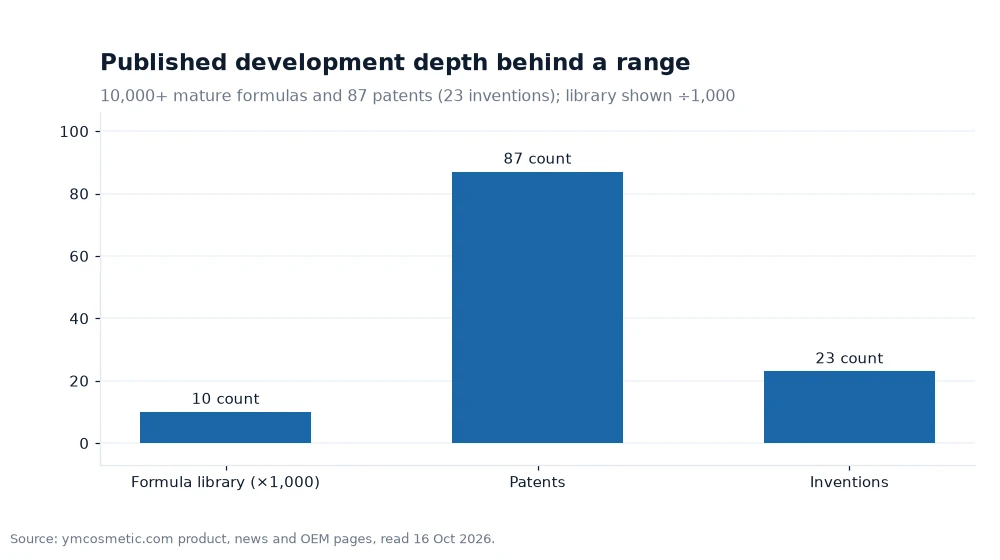
The two numbers worth remembering are 10,000 and 87. The library is large enough to cover wax, emulsion and powder families without starting from a blank page, while 87 patents is a smaller, sharper number that points to how much of that library is protected work rather than shared basics.
Order minimums when a range shares a slot
Minimums are quoted per product, not per range, and that is where a wide line-up gets expensive. The published figure is typically 1,000 to 5,000 units per product, with a 500-unit startup entry for new brands. A five-item range at the low end therefore starts at 5 × 1,000 = 5,000 units, before any shade spread inside an item.
| Category | Base family | Route that fits |
|---|---|---|
| Lipstick | Wax and oil | Existing shade base, ODM |
| Lip gloss | Wax and oil | Existing base, finish tuned |
| Foundation | Emulsion | Shade range build, ODM or OEM |
| Highlighter | Powder or cream | Shared pressed base |
| Eye shadow | Powder | Shared pressed base |
| Makeup remover | Emulsion or oil | Simple base, fast fill |
A lower entry point helps most at this stage. The published 500-unit startup option lets a brand launch one or two items at a time and add the rest as revenue returns, rather than funding the whole range up front. That is often the difference between launching this season and waiting for the next one, and it keeps the first order tied to a shade the market has actually asked for.
Handoff rules that keep a range on schedule
A range slips most often at the handoffs, not inside the laboratory. Freeze the reference shades first, then lock packaging, then book the fill slots in family order. When those three steps are sequenced, an ODM item can move while an OEM item is still in testing, and the range still lands in one delivery window. The buyer's job is to keep those three gates moving in the right order and to escalate early when one of them stalls, because a single late gate resets the date for the whole range.
Naming a single contact for the whole range helps more than any internal tracker. Questions about colour, pack and test status then travel through one channel, and the buyer stops chasing three answers for one decision. The client's overview of colour cosmetics suppliers in China is a reasonable place to see how these routes compare.
Frequently asked questions
Can one factory make a full colour range?
Yes. The client lists lipstick, lip gloss, foundation, highlighter, eye shadow, contour palette and makeup remover, and describes 10,000+ mature formulas and 87 patents, so several families can be built by one partner on different routes.
Is the minimum order counted per item or per range?
It is quoted per product. The published figure is typically 1,000 to 5,000 units per product, with a 500-unit startup entry, so a five-item range multiplies the low end by the number of items.
How long does development take?
An ODM item that uses an existing formula is quoted at 4 to 8 weeks, while an OEM item with new development takes 3 to 6 months. A mixed range ships on the slowest item, so the OEM work should be identified first.
Planning the first range with one partner
Start by sorting the line-up into base families, then decide which items can lean on the existing library and which need development. That single split sets the budget, the sample rounds and the launch date. From there, choose a partner that handles several families rather than one, so the range does not fragment. The lipstick programme is a good test case for how one family is quoted before you scale to the rest.
Published minimums, route windows and facility figures were reviewed on the manufacturer's website on 16 Oct 2026.[1]